 Orvus
The journal
How are AI chatbots used in customer service? A practical guide
AI chatbot for customer service explained, with use cases, implementation steps, KPIs and governance to help teams run effective pilots.

What an AI chatbot for customer service is and why it matters
Short definition and common components: AI chatbot for customer service
An AI chatbot for customer service is an automated system that converses with customers to answer questions, gather context and take simple actions, using components such as natural language understanding, dialogue management and knowledge grounding to produce relevant replies, and integrating with customer relationship management systems for context and logging. This form of automation ranges from rule based menus to conversational self service and to generative assistants that draft replies for human review, and each type has different operational tradeoffs and design needs, as described in recent industry research Zendesk Customer Experience Trends 2026.
The main technical components are familiar: NLU, or natural language understanding, maps text to intents and entities; dialogue flow or conversation state manages turn taking and prompts; knowledge grounding links answers to a maintained knowledge base so responses reflect authoritative content; and CRM or help desk integration supplies account context, tickets and logging. These pieces are commonly combined so that a bot can attempt containment, log a ticket when needed and escalate to an agent with context attached State of Service (6th Edition).
How should my team decide which customer service workflows to automate with a chatbot?
Start by mapping volume and repeatability, choose a narrow high volume domain, confirm knowledge sources and CRM integration, define KPIs and escalation rules, then run a time boxed pilot with human review and dashboarding to decide whether to scale.
How chatbots fit into modern customer experience stacks
In practice, chatbots sit on the front line of a support stack where they handle high volume, repeatable requests and capture structured context for downstream systems. When integrated with a knowledge base and routing rules they can resolve routine questions without agent involvement, and when they cannot, they generate a structured ticket or perform a guided handoff to an agent so the conversation continues seamlessly The state of customer care in 2024.
Governance and transparency are now part of deployment planning, especially in jurisdictions that apply AI disclosure rules. Teams designing chatbots should consider where to display transparency notices and how to log decisions for oversight to meet tightened expectations under regional regulation AI Act enters into force.
Common use cases and workflows for customer service chatbots
FAQ automation and knowledge search
FAQ automation is one of the most common uses for chatbots. In this workflow the bot maps a user query to a knowledge base article or prewritten answer and returns that content, often adding follow up prompts to confirm whether the answer solved the issue. When the bot is grounded on an up to date knowledge base and integrated with the support system for logging, organizations commonly see faster first responses and reliable containment for routine questions Zendesk Customer Experience Trends 2026.
Design notes for FAQ bots include tidy intent sets, clear fallback prompts, and easy paths for customers to request a human. A small but critical design step is to add metadata to knowledge articles so the bot can use content categories, confidence thresholds and recency filters when choosing an answer.
Ticket triage, routing and conversational forms
Chatbots can act as a triage layer that collects structured data, prioritizes issues and routes tickets to the correct team or queue. Rather than sending an unstructured message to the help desk, the bot gathers the customer problem type, severity signals and account identifiers, then creates or updates a ticket with that context so agents receive a complete picture at handoff State of Service (6th Edition).
Effective triage flows use conditional logic to escalate automatically when certain triggers appear, for example when a high severity phrase or a blocked payment is detected. Teams should map the triage rules back to SLAs so routing decisions support existing service commitments and reporting.
Guided self-service and live-agent handoff
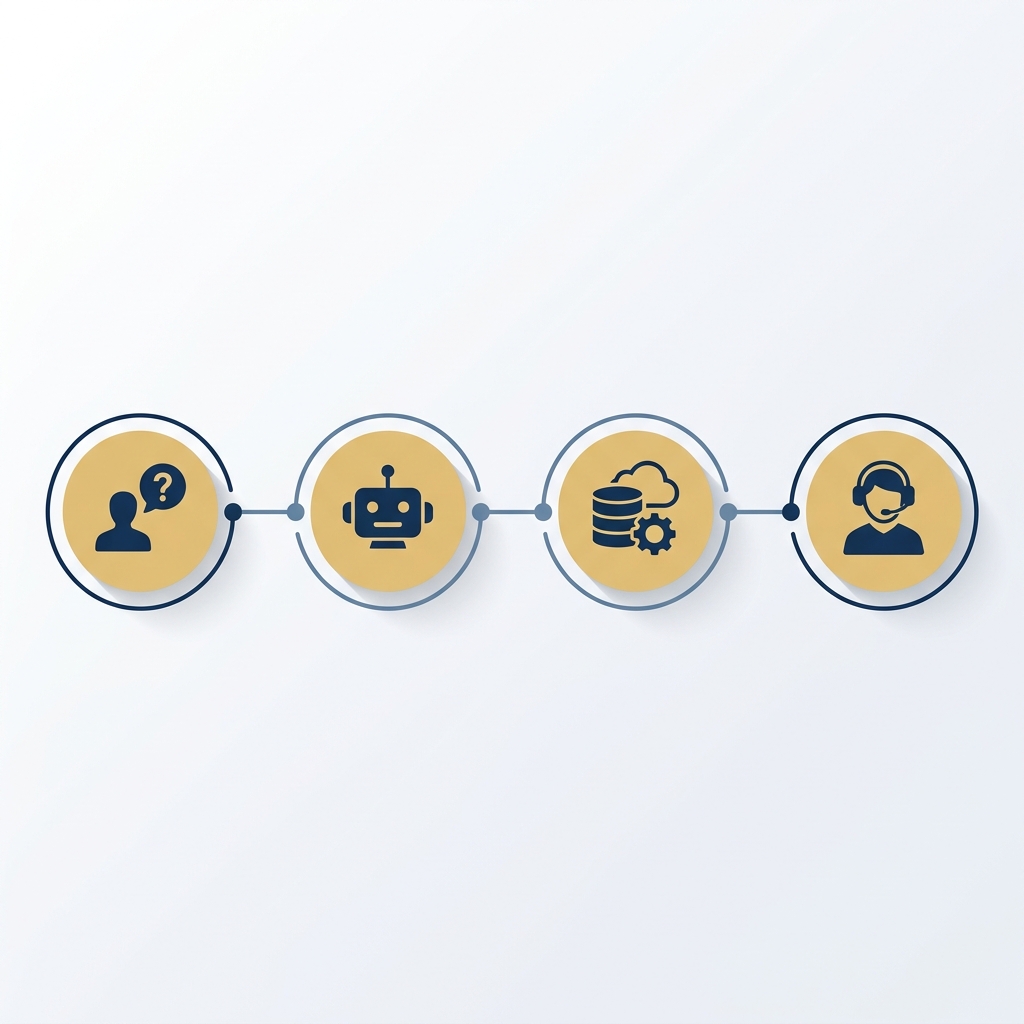
Guided self service uses conversational prompts and micro workflows to walk customers through multi-step tasks, such as account recovery or troubleshooting a product. Where the bot cannot complete the task, a guided handoff packages the dialog history, captured fields and confidence scores so a human can take over without repeating steps, preserving context and customer patience The state of customer care in 2024.
Containment rate, the share of contacts resolved by automation without agent handoff, is the key metric for guided self service. Well integrated systems that measure both technical completion and customer satisfaction for those completed conversations show the best outcomes.
How to implement an AI chatbot: a practical framework
Platform selection and architecture decisions
Choose a platform by matching capabilities to scope: simple FAQ bots need reliable knowledge connectors and intent classification, while agent assist or generative workflows require model assist features and secure logging. Consider hosting options, data residency and how the platform connects to your CRM or help desk for both context and audit trails State of Service (6th Edition).
Architecture choices influence how you control updates and monitor drift. A layered architecture that separates intent models, grounding services and integration adapters lets teams update a knowledge base without retraining intent detectors, which simplifies maintenance and reduces operational risk.
Designing intents, dialogue flows and grounding
Start intent design with a narrow scope that addresses high volume use cases, then expand. Use conversation design to anticipate clarifying questions and misinterpretations. Ground responses on explicit knowledge sources so the bot cites supported content rather than generating unconstrained text, and use confidence thresholds to decide whether to answer, ask a clarifying question or escalate Zendesk Customer Experience Trends 2026.
A practical pattern is to tag knowledge base items with canonical answers and evidence lines. When the bot returns an answer, it also attaches the source or the article id used to build the reply, which speeds human review and auditing.
Integration, human-in-the-loop and rollout steps
Integrations are critical: a bot that cannot read ticket history or update customer records will create friction. Connectors to CRM and help desk systems are needed for context, logging and to trigger workflows such as refunds or account updates. During rollout plan for human review where outputs affect account state, and keep an action log for every automated operation to support rollback if needed State of Service (6th Edition).
Pilot with a limited scope, for example an FAQ domain or a triage workflow during off peak hours, record clear KPIs and collect qualitative feedback from agents and customers. There is empirical evidence that generative assistants can increase agent productivity; one large field experiment observed an average productivity lift, particularly for less experienced agents Generative AI at Work: Evidence from a field experiment on customer support.
KPIs, measurement and governance you must track
Which KPIs matter and how to interpret them
Track first response time, average handle or resolution time, containment rate, customer satisfaction and escalation quality as primary indicators of success. These KPIs together show whether the bot speeds responses, reduces agent load and preserves or improves service quality over time Zendesk Customer Experience Trends 2026.
Containment rate helps quantify how many contacts the bot resolves end to end. Monitor containment alongside CSAT so you avoid a false efficiency win where automation reduces cost but lowers customer satisfaction.
Monitoring, auditing and regulatory expectations
Instrument dashboards to combine ticket metrics, model confidence and qualitative flags from human review. Regular sampling of conversations for audit, paired with escalation quality checks, helps spot regressions early and provides evidence of oversight Artificial Intelligence Risk Management Framework (AI RMF 1.0).
Regulatory expectations tightened after the AI Act entered into force, creating transparency duties for systems that interact with people. That means teams should log decisions, retain provenance for answers and publish appropriate disclosures where required by jurisdictional rules AI Act enters into force.
quick operational checklist for monitoring chatbot performance
Common pitfalls, operational risks and how to avoid them
Typical implementation mistakes
A frequent mistake is launching a broad scope before grounding answers and defining escalation paths. Without clear rules the bot can offer incorrect guidance or create extra work for agents. Start small and instrument closely to avoid these cascading operational costs Generative AI at Work: Evidence from a field experiment on customer support.
Another common error is weak integration with CRM. If a bot cannot read account status or past tickets it will ask customers to repeat information, reducing satisfaction and negating time savings.
Model errors, hallucinations and data quality issues
Generative models can produce plausible but incorrect outputs, a behavior often called hallucination. Mitigations include grounding answers on a curated knowledge base, using conservative confidence thresholds and routing uncertain replies to human review rather than publishing them directly Artificial Intelligence Risk Management Framework (AI RMF 1.0).
Maintain clear data hygiene for the knowledge base, record source provenance and run periodic reconciliation checks so the bot does not surface outdated or contradictory information.
Escalation failures and governance gaps
Escalation failures arise when triggers are missing or mis tuned, for example when a sentiment or urgency signal is not detected. To reduce this risk, define explicit escalation rules that map to SLA classes and test them with representative conversational samples.
Governance gaps often show up as missing transparency notices or inadequate audit logs. Address these with policy documents, a sampling regime for human review and retention policies that support investigations.
Practical examples, decision checklist and next steps
Short example scenarios and expected outcomes
Scenario one, an FAQ bot pilot: scope five high volume questions, ground answers on the support portal, and measure containment and CSAT over four weeks. Expect faster first responses and a clear signal on whether content needs editing before scaling Zendesk Customer Experience Trends 2026.
Scenario two, a triage bot: implement a conversational form that captures issue type, severity and account id, then route to the correct queue. Success looks like higher routing accuracy, fewer reassignments and reduced average handle time for incoming tickets State of Service (6th Edition).
A one-page decision checklist to start a pilot
Checklist essentials: define objectives, select a narrow scope, confirm knowledge and CRM integrations, set KPIs and sampling rules, define escalation paths and transparency notices, and plan a four to eight week pilot with daily monitoring. Use the checklist to align stakeholders before development starts.
Sample size guidance: choose a volume that gives you hundreds of interactions in the pilot window so you can see error modes, but keep the scope limited enough to investigate issues quickly.
What success looks like and how to scale
Success includes measurable improvements such as reduced first response time, increased containment without CSAT decline and fewer repetitive tasks for agents. To scale, expand scope iteratively, maintain the grounding process and automate retraining or content updates only after human validation.
When scaling, preserve human in the loop for high risk actions and audit a representative sample continuously to prove that quality and compliance controls remain effective Artificial Intelligence Risk Management Framework (AI RMF 1.0).

Frequently asked questions
How quickly can a chatbot reduce response times?
A well integrated chatbot can reduce first response time immediately for routine queries, but measurable operational gains depend on scope, knowledge quality and integration with CRM, so pilots with clear KPIs are recommended.
Will a generative assistant replace support agents?
Generative assistants are most effective as agent assist tools that increase productivity and handle routine tasks; evidence shows productivity gains vary and human oversight remains important.
What governance steps should we prioritize?
Prioritize transparency notices where required, logging and provenance for answers, human review sampling and alignment with an AI risk management framework.
AI chatbots can deliver faster responses, cost efficiencies and better agent productivity when they are carefully scoped, properly grounded and integrated with CRM and knowledge systems. Use staged pilots, clear KPIs and human review to validate benefits before wider rollout. For regulatory questions and detailed compliance steps consult the primary sources cited in this guide and align internal policies with a structured AI risk management approach.
References
- https://www.salesforce.com/resources/research-reports/state-of-service/
- https://www.mckinsey.com/capabilities/operations/our-insights/the-state-of-customer-care-in-2024
- https://commission.europa.eu/news/ai-act-enters-force-2024-08-01_en
- https://www.nber.org/papers/w31161
- https://www.nist.gov/itl/ai-risk-management-framework